

The Arts & Workforce Readiness
Our Fine Arts programs are not merely studios for "making"; they are laboratories for thinking. While the world often views our work through the lens of a "beautiful image," our true curriculum is the development of a complex, multifaceted language. We teach students to see with acuity, translate abstract concepts into tangible solutions, and communicate across visual and oral mediums.
In an era defined by rapid technological shifts and "wicked" problems, the AFA degree provides the ultimate foundation for the workforce. We are cultivating the very competencies that CEOs and industry leaders identify as their highest priorities: critical thinking, innovative problem-solving, and cross-cultural communication. We do not just prepare students for a job; we equip them with the cognitive agility to navigate a career landscape that does not yet exist.
"Visual arts education develops skills of deeper understanding and divergent thinking... cultivating collaboration, communication, critical thinking, curiosity, innovation, and problem solving—key competencies desired by employers."
— National Art Education Association (NAEA)
Our Fine Arts programs are not merely studios for "making"; they are laboratories for thinking. While the world often views our work through the lens of a "beautiful image," our true curriculum is the development of a complex, multifaceted language. We teach students to see with acuity, translate abstract concepts into tangible solutions, and communicate across visual and oral mediums.
In an era defined by rapid technological shifts and "wicked" problems, the AFA degree provides the ultimate foundation for the workforce. We are cultivating the very competencies that CEOs and industry leaders identify as their highest priorities: critical thinking, innovative problem-solving, and cross-cultural communication. We do not just prepare students for a job; we equip them with the cognitive agility to navigate a career landscape that does not yet exist.
"Visual arts education develops skills of deeper understanding and divergent thinking... cultivating collaboration, communication, critical thinking, curiosity, innovation, and problem solving—key competencies desired by employers."
— National Art Education Association (NAEA)
Where Our Graduates Go
According to the National Art Education Association (NAEA), when CEOs were surveyed, creativity was identified as the number one trait sought when hiring. Fine arts programs are the primary engines for this "creative readiness."
Research published by the National Institutes of Health (PMC) suggests that visual art learning relies on a complex system of perceptual and higher cognitive functions. This suggests a "shared neural substrate" that allows for the transfer of learning and creativity to other cognitive domains like science and language.
The U.S. Bureau of Labor Statistics (BLS) notes that the median annual wage for arts and design occupations ($53,180) is higher than the median for all occupations, with over 84,000 openings projected annually.
The American Academy of Arts and Sciences reports that arts education strengthens social ties and cognitive skills used by both "artists and non-artists in their livelihoods," making it central to a well-rounded workforce.
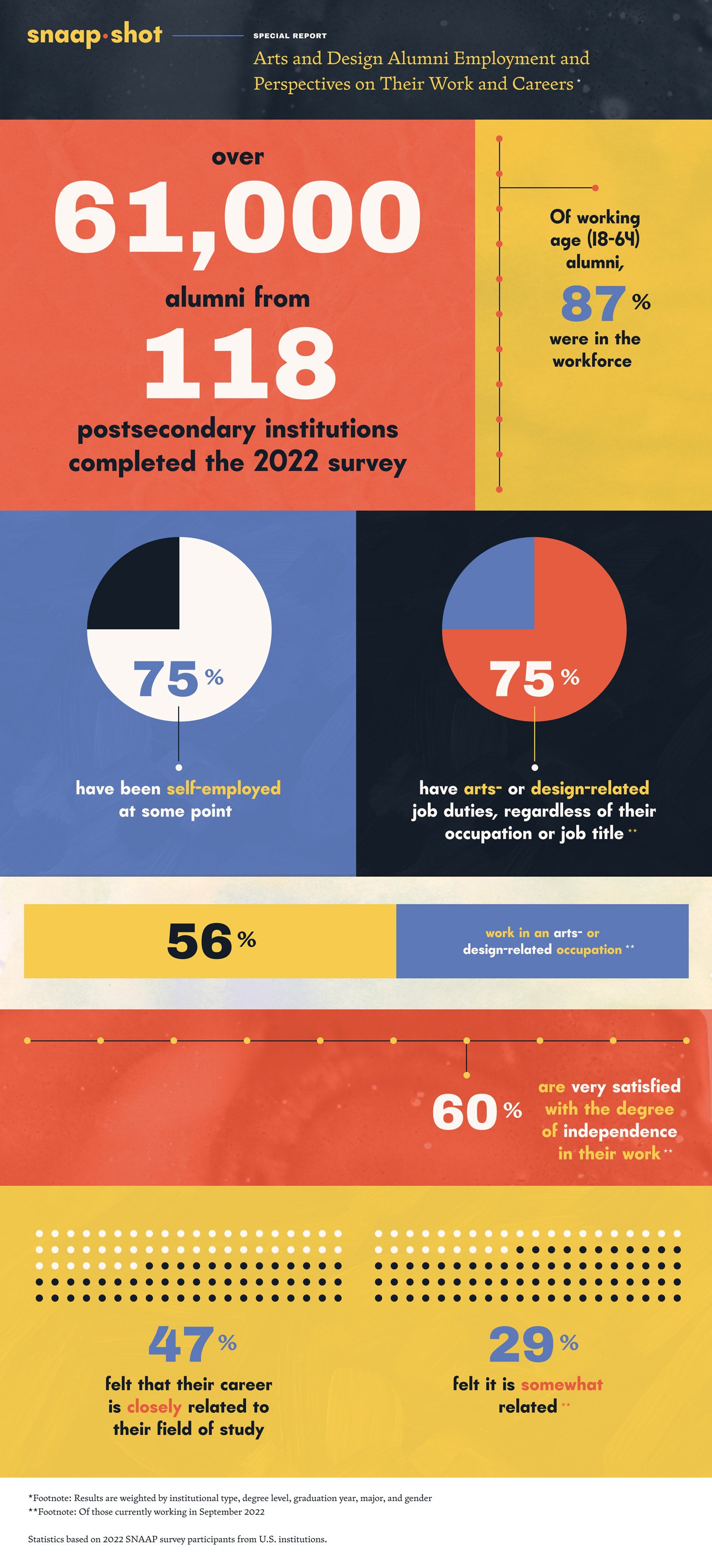
Data from the Strategic National Arts Alumni Project (SNAAP) and the Bureau of Labor Statistics demonstrate that while many art students remain in the "Creative Industries," a significant portion of them translate their skills into diverse sectors.
The Translation of "Visual Language" to Professional Success
Art students succeed in non-traditional fields because they are trained in a specific "meta-language" that is highly transferable:
Iterative Problem-Solving: The "critique" process is essentially the scientific method applied to aesthetics. Students learn to take feedback, pivot, and refine—a skill vital in Agile software development and corporate management.
Visual Literacy in a Data-Driven World: As data becomes more complex, the ability to interpret and communicate information visually (Information Design) is a high-demand skill in finance, tech, and governance.
High-Level Observation: Fine arts teach "seeing" rather than "looking." In fields like medical diagnostics or criminal justice, the ability to notice subtle patterns and anomalies is a direct extension of studio training.
Innovation through Constraints: Working within the limits of a medium (or a budget) forces students to develop innovative, out-of-the-box solutions, which is the cornerstone of entrepreneurship.